


Browse all topics
Samples
-
We offer hundreds of free samples so you can test our products with your food and beverages before purchasing a case or pallet. Sample orders ship for a $5 flat rate within the continental United States, with up to 30 sample items per order—no coupon code required.
You can order samples by visiting any product page and looking for the green "Try A Free Sample" button near the product description. You can also browse our full collection of samples.
If you don’t see a sample available for a product you’re interested in, please contact our client service team, and we’ll be happy to help.
Please note: Sample items use the same SKU as stock products, but without the “S-” prefix. Samples are provided to demonstrate product size and material only. Due to manufacturing updates, certification transitions, and normal production tolerances, samples may vary slightly from stock products. Samples are not food safe and are intended for testing and evaluation purposes only.
Shipping
-
For safety and insurance reasons, we do not offer in-person pick from our warehouses. Note that most orders ship within one business day and any orders placed before 10:30 am Eastern Time are processed the same day.See our Shipping & Returns Policy for more information.
-
Currently, we only direct ship samples internationally.If you are located outside of the U.S. or Canada, we can ship your order to you using an intermediary U.S.-based freight forwarder. We ship your order to the freight forwarder, and they ship it to your international address from there.
Freight forwarding businesses are frequently used for international shipping and are widely and easily available. These businesses are generally located in all major U.S. port/coastal cities.
Using a freight forwarder is easy:
1) Contact a freight forwarder and make arrangements with them. It may be best to find a freight forwarder on the coast of the U.S. closest to your country. For example, if shipping to the Caribbean, Miami or Jacksonville-based forwarders are good options. If shipping to Europe, Boston or New York would likely be ideal.
2) Create your cart and check out on our website using your name and address for billing. Use the name and address of your freight forwarder for the shipping information. They should take care of the rest!
Ordering
-
Yes, we offer buy now, pay later payment through Credit Key. With Credit Key, you can choose to split the cost of your purchase into 4 interest-free payments, or, if you want lower payments, extend the financing to a 6-12-month term. Select Credit Key at checkout or Get Pre-Qualified Now.The application only takes a few minutes to complete, and approvals are immediate. After you're approved, you can use Credit Key for future Good Start Packaging purchases. Available for all purchases. US customers only. Subject to credit approval. Learn More.
-
Once an order is submitted, we're unable to add items to it. If you need anything else, just place a new order and we'll get it on its way as quickly as possible.
-
No, we offer a convenient Guest Checkout option. Creating a Good Start Packaging account is quick and easy though and has many benefits including:-Faster checkout
-Save multiple shipping addresses
-Access your order history and quick reorder
-Track new orders
-Save items to your Wish ListAlready checked out as a Guest? No problem! Create an account then contact us to have your orders linked.
-
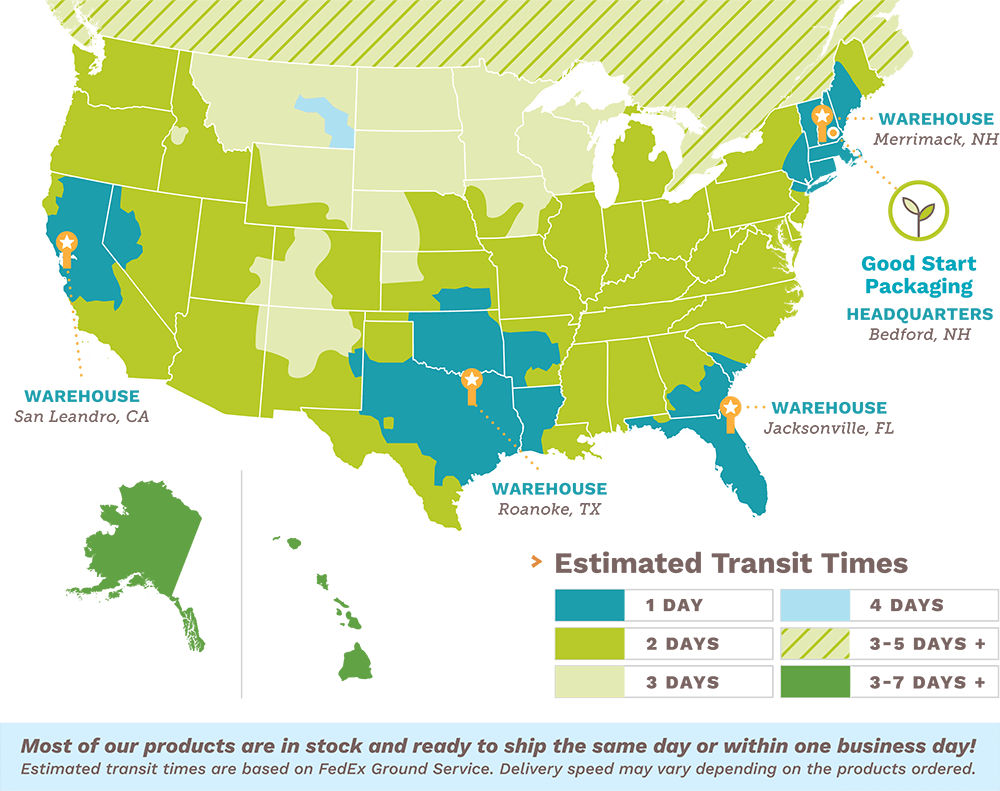
We ship via ship via FedEx Ground. Most orders ship within one business day. Orders placed before 10:30 am Eastern Time will ship that day.
Large pallet-sized orders ship via FedEx Freight or 3rd Party Freight Carriers within 1-3 business days. For multiple pallet orders contact us for a custom quote. Shipping times may vary depending upon the product ordered. Estimated Shipping Time will show in checkout.
Sales Tax
-
Good Start Packaging collects and remits sales tax for sales in certain states. If you're purchasing products for use in these states, they may be exempt from sales tax.We can flag your Good Start Packaging account so that you won't be charged sales tax at checkout. Please visit our Sales Tax Exemption page to learn which states require sales tax and the documentation needed to add an exclusion to your account. This process is quick and usually takes less than one business day to complete.
Please note that it is your responsibility to ensure that your business is eligible to claim an exemption from state sales tax. If you're unsure, contact a tax professional for advice before you apply for tax exemption with us.
Sales tax collected from past orders prior to receiving sales tax exemption status can NOT be refunded. If you are submitting to become tax exempt, please hold off on ordering until your exemption is processed and you receive a confirmation email.
Returns
-
All items, with the exception of sale/clearance items, may be returned if the items are unused and in the original unopened manufacturer’s packaging. Our items are used in food service, and due to food safety regulations, we cannot accept opened merchandise unless the items were either shipped in error or damaged in shipping.- Items must be returned within 30 days from receipt of your order.
- Please contact our Client Service team at (866) 971-9251 extension 1 or through our contact form for a return label and instructions.
- You will be responsible for return shipping plus a 15% restocking fee which will be deducted from your refund.
- Upon receipt and inspection of the returned items, we will credit you, less these fees, to the original form of payment.
We strongly encourage all shoppers to take advantage of our large assortment of free samples to try out our products prior to purchasing full cases.
Please see our complete shipping and return policy here.
-
If any part of your order is missing or damaged, please keep the items and packaging and contact us within 5 business days of receipt so we can find a solution for you.For damaged products, please include multiple photos of the containers and packaging.
If you do not contact us within 5 business days of the delivery date, we cannot guarantee any compensation for damages or loss.
Composting Questions
-
Generally speaking, no. Compostable products shouldn't be put into the recycling bin. They can cause problems in the recycling stream if intermixed with petroleum-based plastics that are non-compostable. The best way to dispose of compostables is to compost them along with other organics like food scraps in your backyard pile (if home compostable) or to send them to a commercial composting facility, where they’ll break down into soil with the right mixture of heat, microbes, and time.There are exceptions: Recyclable paper products like paper bags, coffee cup sleeves and paper clamshell produce containers are both 100% recyclable and compostable but should be recycled if possible in order to reuse the material.
-
We created this list of U.S. composters to help you find a compost facility near you.Another way to find a commercial composting facility in your area is to contact your local waste management service. To ensure that your products are properly composted, ask if the site accepts compostable foodservice wares and inquire about any restrictions or banned materials or products. You can also learn more about commercial composting in our helpful article.
-
Microorganisms, carbon, water, and oxygen are all necessary elements of composting.
If compostable products are sent to an open landfill or dump where oxygen is available, most will degrade at a rate similar to other biodegradable materials in the same setting.
If compostable products are sent to the more common air-tight landfill and deprived of oxygen and microorganisms, they will decompose over a very long period of time along with all other waste brought to these facilities. These kinds of landfills are not designed to break down waste, only to store it.
Despite this fact, there are significant upstream benefits of compostable packaging including being made from renewable, less toxic materials by conscientious companies. For more information, check out this article about this topic.
-
The products we carry are designed to break down and be returned to the soil through composting at the end of use. Most commonly this occurs at commercial composting facilities where practices like mixing the materials, turning large piles, and monitoring heat and moisture levels allows compostable packaging to break down within 2-4 months. These practices create ideal composting conditions that speed up decomposition time. Composting also reduce methane emissions by keeping packaging out of landfills.We also offer a growing line of home compostable items that break down even faster and in a home setting. This includes popular PHA straws that are home compostable and marine-degradable!
Compostable products break down at different rates, depending on the material they are made from and its thickness, as well as the conditions in the composting environment. Home composting rates are typically slower and can vary widely depending on how frequently the pile is turned over, the moisture and material content, and the temperatures the home compost pile can reach.
-
If you live in an area where commercial composting service is not available, there are still upstream benefits to be realized in choosing compostables.Compostables are made from renewable and compostable materials including corn, sugarcane stalks, wheat straw, and bamboo that do not contain toxic chemicals. They use fewer resources to manufacture and produce less pollution than their plastic counterparts. What's more is that compostables make use of agricultural byproducts like bagasse, the fibers remaining after sugarcane stalks are crushed for juice. These materials would typically be burned or thrown away but are instead used in the production of compostable products, reducing waste and creating an extra income source for farmers.
Lastly, choosing compostables sends a powerful buying signal into the marketplace. That signal shows manufacturers they’ll be rewarded for continuing to innovate and drive down costs of plastic-free packaging. It also sends a signal to municipalities that they should enable more permits to be created for commercial compost facilities to process these products into usable compost instead of filling up landfills. Lastly, choosing compostables empowers your customers to enjoy their food in plastic-free and toxic-free packaging. For more information, check out our article about this topic.
-
Our compostable products at a minimum meet ASTM D6400 and/or ASTM D6868 standards for compostability.In addition to this, most of the packaging and supplies we carry are certified compostable by a variety of third-party organizations. The organization used for certification typically varies by manufacturer. If a product is certified, it is noted in the "Features & Benefits" section in its product description. These organizations include BPI or Biodegradable Products Institute, CMA or Composters Manufacturing Alliance, TUV Austria, and more. For more information, check out our article on composting standards and certifications.
Additionally, we have a growing line of Certified Home Compostable items, which break down the fastest without the temps required by commercial composters.
Note that some companies claim their products are "Biodegradable" which is not the same or as good as Compostable as technically everything biodegrades over time. Learn more about the difference between biodegradable versus compostable.
Product Questions
-
Our compostable products not only break down into soil, but through their production and disposal, they use less energy and water. They also release less harmful pollutants than their conventional counterparts like foam and plastic. For example, you can make two compostable forks with the same amount of energy it takes to make one plastic fork and three compostable plates with the same amount as one foam plate. That’s a 66% savings of energy. Using less energy means producing less greenhouse gas and emitting less carbon dioxide into the atmosphere.Conventional plastics are manufactured from 20 different petroleum-based resins with 20 different levels of recyclability and toxicity. As a fossil fuel, petroleum is a non-renewable resource and its extraction process degrades the environment. Due to the difficulty and complexity of recycling, over 20 million tons of plastic are sent to landfills each year.
All of the brands and products we sell are personally vetted by our team. We list all product specs, materials, and compostability certifications on each page for your shopping convenience. Check out our Learning Center for more information on Compostable Materials, Problem Materials, and Composting Standards and Certifications.
-
The products we carry are made from a wide variety of compostable materials to satisfy a diverse range of end uses. For a more in-depth look at each material, see our Compostable Material Guides.Plant Fiber
The main source of plant fiber is wheat straw, though it is occasionally supplemented by sugarcane and bamboo. In many agricultural processes, wheat straw is treated merely as the agricultural waste that remains after the grain is extracted. It is commonly thrown away or burned. Straw is a valuable resource that can be molded into disposable, compostable products like plates, take-out containers, bowls, etc. Using plant fiber protects forests, uses less energy and emits fewer toxic chemicals than paper alternatives. It also provides an extra income source for farmers, and is a renewable and sustainable resource.Bamboo Paper
These days, many tree-based paper disposables can be replaced by renewable plant fibers like the FSC® certified bamboo paper products in our NoTree Collection. Bamboo is the world's fastest-growing plant!Recycled Paper
While we believe that the best way to protect the world’s forests is to reduce the consumption of tree-based products, many of our customers want products that cannot yet be replicated by plant fiber such as paper bags. The paper products we carry are mostly made with recycled paper and are typically certified by the Forest Stewardship Council guaranteeing the responsible management of the forests.Polylactic Acid (PLA)
PLA is a bio-based plastic derived from renewable resources such as corn starch, tapioca roots, and sugarcane. Our PLA products are generally made from a type of PLA called Ingeo™. To make Ingeo™, sugar from plants is turned into lactic acid through fermentation which is converted into polymer. At this stage, it is shaped into pellets which can later be transformed into a wide variety of products. Manufacturing Ingeo™ produces 75% fewer greenhouse gasses and uses 50% less non-renewable energy than traditional polymers like PET & polystyrene.cPLA and tPLA
cPLA and tPLA were developed to provide the base PLA material with improved rigidity and heat resistance.cPLA = crystallized PLA. It’s processed by applying high pressure and heat to PLA, chalk, and other biodegradable and bio-based additives. This causes the material to crystallize, resulting in a harder product that’s less susceptible to heat degradation. CPLA lids are commonly used for coffee cups.
tPLA = talc-injected PLA is created by combining the two materials at a ratio usually around 70% PLA and 30% talc. Talc is a natural mineral that helps PLA mold into harder materials. For that reason, tPLA utensils are a common eco-friendly option. Talc is not renewable but it is an abundant natural resource.
Cellophane
Cellophane is created from the cellulose taken from cotton, wood, hemp, or other sustainably harvested natural sources. It starts as a white dissolving pulp, which is 92%–98% cellulose. Then, the raw cellulose is converted into cellophane. We carry a variety of flat and gusseted cellophane bags as a sustainable alternative to plastic bags.Polyhydroxyalkanoates (PHA)
PHA is a polymer that is produced naturally through the process of bacterial fermentation. This process uses microorganisms to convert sugars or lipids into a compostable bioplastic that is marine degradable and compostable. We carry PHA straws that are certified home compostable and marine-degradable. -
Product shelf life varies by material and product. Kept in ideal conditions, many compostable products can last longer than their stated shelf life. We operate climate-control warehouses across the United States to extend the shelf life of our products before you even receive them.-Plant fiber plates, take-out containers, bowls, cups, & trays, etc.: 3 years
-PLA cold cups, PLA deli containers, etc.: 2 years
-Paper hot cups & bowls: 2 years
-TPLA utensils: 3 years
-Bamboo utensils: 3 years
-Trash bags, shopping bags, kitchen bags, etc.: 12 months
-Heat-resistant cPLA lids for paper cups: 12 months
-PHA straws: 2 yearsProducts should be stored in a cool dry area out of direct sunlight to achieve maximum life expectancy.
-
Paper sources vary between manufacturer and product line but below is a general list. Please check the product description of each product for exact details.- The NoTree Collection is made from a renewable byproduct of bamboo farming and includes no tree fibers.
- White Paper Hot Cups* are made from sustainably harvested paper certified by the Forest Stewardship Council (FSC). This certification verifies that a forest is responsibly managed to mitigate the common destructive consequences of logging: habitat destruction, water pollution, displacement of indigenous peoples, and violence against wildlife and people who work in the forest.
- Paper Napkins are made from 100% post-consumer recycled paper.
- Hot Cup Sleeves are made from 90-100% post-consumer recycled paper depending on manufacturer.
- Paper Take Out Bags are made from 100% recycled paper; at least 60% of which is post-consumer.*Double-walled hot cups are made from paper certified by the Sustainable Forestry Initiative and are not FSC certified.
-
PLA-based and PLA-lined products should be stored away from heat sources and in a temperature-controlled environment. PLA has a temperature threshold of 110 degrees.The main culprits for PLA items melting and warping are cases or sleeves being exposed to direct sunlight (e.g., left outside, not being stored immediately following delivery, etc.). Or cases or sleeves not being stored in a temperature-controlled environment (e.g., a hot kitchen, a non-air-conditioned pantry/storage space, a hot food truck, etc.).
Take steps as soon as your PLA products are delivered to ensure they are stored properly. For more info on PLA, check out our Guide to PLA.
-
For most take-out, delivery, or leftover applications, our standard unlined fiber to-go boxes, clamshells, bowls, and trays are very effective.
For grab-and-go options and take-out items that have high liquid content or need to hold up for several days, consider premium PLA-lined fiber containers. The clear, bio-based, plastic-free lining of these containers provides an extra barrier for additional leak prevention.
These unlined and PLA-lined fiber containers are both 100% compostable in a commercial composting facility. We encourage you to try free samples of PLA-lined and unlined containers to compare using your own menu items before purchasing a case.
-
Currently we do not carry trays that can work with heat sealers and film. -
At this time, we do not offer labels for bottles. Please see the product description of each bottle for specific label size dimensions should you want to order labels from a third-party vendor. Many of our clients will also order juice bottle samples as well to test their ideas out.Don't forget to encourage recycling on your labels!
-
Our juice bottles are made of BPA-Free PET plastic, which is heat resistant only up to 140 degrees. They are designed for cold beverages and cannot withstand the higher temperatures needed for hot fill pasteurization.The bottles can be used in High-Pressure Pasteurization (HPP) applications.
We suggest ordering and testing samples in your specific scenario prior to ordering in bulk. Juice bottle samples come with lids and can be ordered individually.
-
The Square bottles have more rounded edges, and are slightly shorter and wider than the WH bottles. The sides of the Square bottles have an arched edge at the top, while this part of the WH bottle sides is more angular in shape.The Square WH bottles are taller and more slender, with more angular edges. All of our bottles have the same neck opening size, meaning the caps we sell fit every size and shape bottle we have available. Shop all Square Juice Bottles
-
Plant Fiber Products
Fiber-based containers like to-go boxes and trays, burrito bowls, and clamshells are designed to hold hot food and drinks up to 450°. They are microwaveable up to 2-3/4 minutes for unlined products and 5-3/4 minutes for lined products.Paper Products
NoTree Paper hot cups and bowls made from sustainably harvested bamboo paper are designed to hold hot food and drinks but are not microwave-friendly.PLA Products
PLA (polylactic acid) containers made from corn starch are not designed for hot foods and should be stored away from heat sources. These cold cups, salad bowls, and deli containers are best for room temperature or cold items.Looking More Reheating Power?
Explore new plant-based rigid bio-plastic containers designed for at least 5 cycles of 2 minutes each.*
**Residential microwave (1300 Watt) -
Product lids are sold separately to allow clients a wider range of options and product use. Many items have a variety of lid options and materials based on performance needs, preference, and budget.Some clients such as breweries or cafes may not need lids as the cups and trays are being used for in-house serving purposes.
Juice bottle caps are available in 9 different color options to allow our clients to choose their look.
-
Did you know there are 6 main types of corn?The corn-based PLA products we carry like deli containers, salad bowls and clamshells are made from No. 2 yellow dent field corn, the most abundant and cheapest source of fermentable sugar in the U.S. Also known as "grain corn" field corn is not ideal for human consumption due to poor taste and is primarily grown for livestock feed and ethanol production among many other things. Some "food products" like high fructose corn syrup are made from dent corn as well.
The corn we buy to eat are varieties of "Sweet Corn". Some "popcorn" varieties of corn are cultivated specifically for popping. Flour corn, pod corn, and flint corn make up the remaining 3 varieties.
-
Sugarcane and Bamboo-based products are made from non-GMO material and byproducts. Additionally, Most BioBag products we carry are Non-GMO Verified. PLA and Fiber-based products are not Non-GMO Verified.There is a lack of access to GMO-free crops that could be affordable to consumers. Currently, 86% of the corn grown in the U.S. is GMO, with 45% of it being used for livestock, poultry, and fish production and 27.5% for ethanol production. This is mainly No 2 Yellow dent field corn which is generally not consumed directly by humans due to poor taste.
While we would prefer not to purchase products with a GMO-base, our primary goal is to lessen our reliance and dependency on petroleum-based products.
We look forward to more regulation in this arena similar to the EU but unsure if this would affect non-consumable corn products.
-
YES it is safe! PLA is a byproduct of corn starch. When food, like corn starch and corn byproducts, are heated past the heat-labile point, its chemical configuration changes.Due to the extreme heat and numerous processing steps required to convert corn into feedstock and then to PLA, it would not contain immunologically reactive profilin and therefore there are no concerns regarding allergic reactions from PLA.
-
NO! While our products are generally non-toxic and compostable, they are not intended for human consumption. If accidentally ingested, contact your physician.Additionally, they are safe to use by people with gluten allergies or corn allergies.
-
YES! The fiber products we carry are mostly made from bamboo and sugarcane bagasse or perennial grasses. Wheat straw is not commonly used these day. Gluten is a protein typically found in the seeds of wheat used for food production.
Fiber products with wheat straw fiber are made from parts of wheat plants that are not used for food, like leaves and stalks, making them gluten-free.
This wheat straw, like sugarcane bagasse is a byproduct of farming that would typically be thrown out or burned. Using plant fiber provides a new revenue for farmers, protects forests, and uses less energy and fewer toxic chemicals than paper alternatives.
-
The juice bottles we carry are not intended for carbonated beverages.Most carbonated beverages, such as soda, produce up to 40 PSI of pressure. This type of pressure requires a peddler or footed base (such as 2-liter soda bottle) and a higher stretch ratio for the plastic.
The juice bottles we carry cannot withstand more than 5 PSI. If more than this amount of pressure is applied to our bottles, the base of the container will roll out.
-
Yes! Our juice bottles are manufactured and packaged in a sterile facility. While they are not individually sterilized, they are FDA-approved as food-safe and ship bagged in cases or on pallets.Additionally, they are also IMS Certified, FDA approved, and HPP compatible. They are also widely accepted in recycling facilities. Shop our line of recyclable BPA-Free Juice Bottles.
-
Our juice bottles are not intended for freezing. In the freezing/thawing process, these PET bottles will expand and could potentially crack. We always recommend trying free samples first to test our products firsthand for your specific use case. -
Many of our items are microwave-friendly and do not leach harmful chemicals when heated like plastic and foam-based containers.
Our Plant Fiber Products like fiber to-go boxes and trays and clamshells will handle hot food and beverages up to 450° F. They are microwaveable up to 2-3/4 minutes for unlined products and 5-3/4 minutes for lined products.While our paper Hot Cups, Bowls, and To-Go Boxes are designed to hold hot foods, certain microwaves may generate extremely high heat that could damage the seams or in some situations burn or ignite the paper. We recommend testing our products in your operations to ensure they meet your specific conditions. We have samples available for most containers. PLA products are not microwave-friendly.
-
Recycling symbols #1-6 are reserved for plastic products. Bio-plastics and all other plasticized products, fall under the #7 symbol as "Other" although they are not always labeled as such. Sometimes they can be labeled as "0".
Look for the word “compostable” or a certification logo like the green swirl design from the Biodegradable Products Institute.
-
No! Our products are not made with intentionally added PFAS. Many of our compostable products are certified compostable by 3rd parties. These certifications specifically test for the presence of added chemicals including PFAS. PFAS has largely been phased out of food packaging in the US since 2023 when it was banned by states like NY, CA and WA
Custom Printing
-
We always try our best to find the right product for your business needs. We can custom print your food and drink packaging and may be able to accommodate custom-sized items including compostable cellophane bags.Contact us with details about your needs and one of our team members will assist you!
-
Our minimum order quantities for custom printed food packaging are set by our various manufacturers. These minimums tend to be high because the manufacturers have to shut down their stock production lines to produce custom-printed products. Note that we offer climate-controlled storage for custom printed products if on-site storage is not available at your location.If the minimum order quantities are too high for your business right now, many of our clients utilize custom stamps, stickers, or labels to brand their packaging depending on the material. For smaller or new companies, these options are more practical and accessible in terms of both capital investment and inventory commitment.
For your convenience, we have identified a couple of DIY branding resources whose quality products have worked well for many of our clients in the past:
1. Custom stamps from EspressoParts.com are a cost-friendly and low-risk solution. Submit your logo and size preference, and they will have a customized rubber stamp delivered to you in less than two weeks.
2. Compostable labels can be found online. We hope to carry these soon.
-
We have custom print samples available for a variety of pre-existing printed products but cannot print samples with your logo. When ordering custom samples, a variety of prints is generally included where available so you can see an assortment of styles, sizes or colors.
All Custom Orders will be provided with a digital mock up/proof for your approval before being printed. Visit our Custom Printing page to learn more.