

In this article, we'll cover:
- What is Extended Producer Responsibility (EPR)?
- How Extended Producer Responsibility Works
- Who qualifies as a producer under EPR?
- Which packaging materials do EPR laws cover?
- How are EPR Fees Calculated?
- Who pays under Extended Producer Responsibility?
- What are the current EPR Laws in the U.S.?
- Does compostable packaging reduce EPR Fees?
- What should you look for in a packaging partner under EPR Laws?
What is Extended Producer Responsibility (EPR)?
Extended Producer Responsibility (EPR) is a regulatory framework that holds manufacturers accountable for the lifecycle impact of their products and packaging, especially the cost and management of recycling, collection, and end-of-life disposal.
In simple terms, EPR shifts waste responsibility from taxpayers and municipalities to the companies that produce packaging and products.
Under EPR laws, producers may be required to:
- Register with regulatory agencies
- Report packaging volumes
- Pay recycling or stewardship fees
- Fund collection and recycling programs
- Meet recycling or recovery targets
EPR policies are rapidly expanding across the U.S., Canada, and Europe, particularly for packaging.
How Extended Producer Responsibility Works
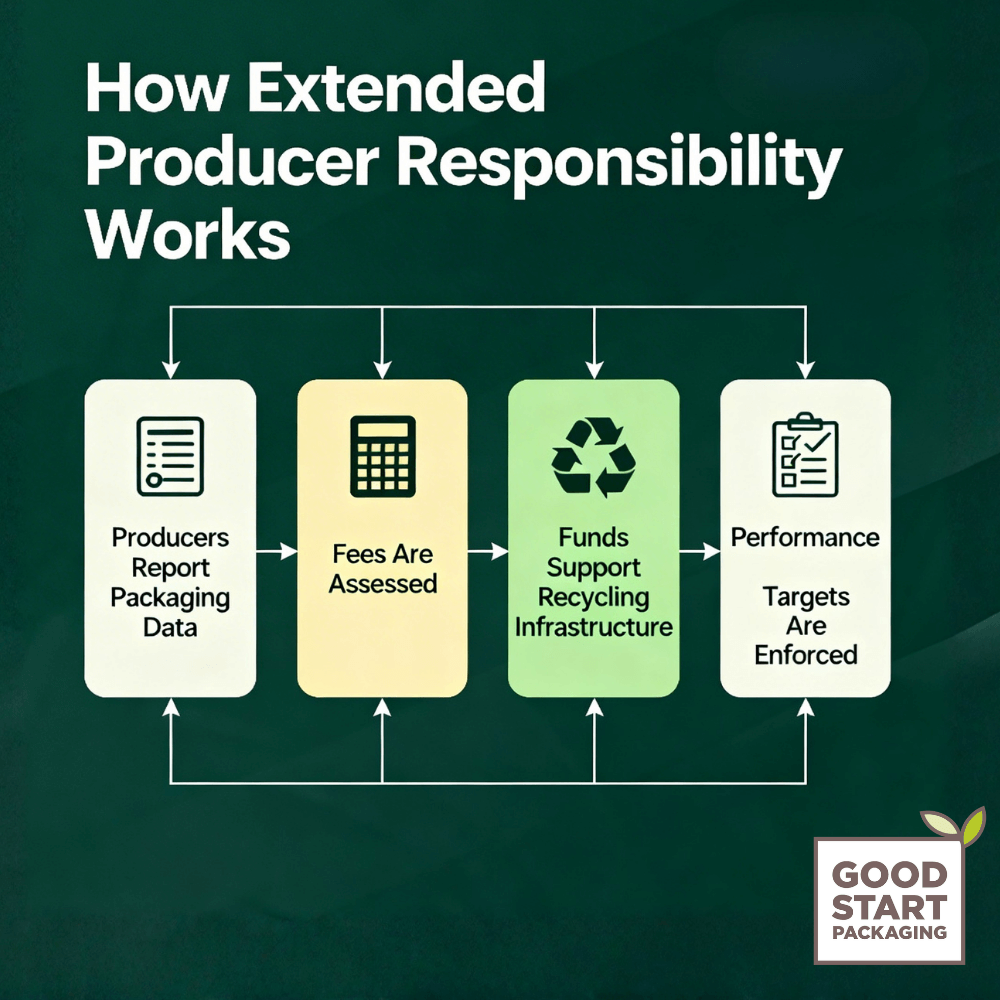
EPR programs operate through a structured compliance system.
1) Producers Report Packaging Data
Companies disclose how much packaging they introduce into a market.
2) Fees Are Assessed
Fees are based on packaging material type, recyclability, and environmental impact.
3) Funds Support Recycling Infrastructure
Companies are charged fees to help finance recycling systems, waste diversion programs, and public education.
4) Performance Targets Are Enforced
Governments establish recycling or recovery benchmarks that producers must meet. Many regions also require producers to join a Producer Responsibility Organization (PRO) to manage compliance.
These are organizations that help companies meet recycling and waste laws by collecting fees from producers and managing the recycling or disposal of their packaging and products on their behalf.
Who Qualifies as a Producer Under EPR?
In EPR legislation, the “producer” is usually:
- The brand owner listed on the product
- The importer bringing goods into the U.S.
- The manufacturer (if no brand owner is identified)
The definition of producer is central to EPR compliance and varies by state.
Which packaging materials do EPR laws cover?
Most U.S. packaging EPR laws apply broadly to:
- Plastic packaging
- Paper and cardboard packaging
- Metal containers
- Glass packaging
- Foodservice packaging
Durable goods and specialized materials may be excluded, but consumer packaging is generally covered comprehensively.
The goal is to reduce landfill waste, increase recycling rates, and encourage more sustainable packaging design.
For packaging suppliers and brands, EPR creates a financial incentive to:
- Reduce unnecessary materials
- Increase recycled content
- Improve recyclability
- Shift to compostable or fiber-based alternatives

How are EPR Fees Calculated?
Producers must report the amount and type of packaging placed into a state’s market.
EPR fees are typically based on:
- Weight of packaging
- Material type
- Recyclability or compostability
- Ease of processing within the existing infrastructure
Many recycling programs use something called modulated fees, which means companies pay different amounts based on how easy their packaging is to recycle. If packaging is made from simple, widely recyclable materials, the fee is lower. If it’s made from mixed materials, hard-to-separate layers, or materials that rarely get recycled, the fee is higher.
In simple terms, the harder your packaging is to recycle, the more you pay. This encourages companies to design packaging that’s easier to recycle, use fewer materials, and avoid unnecessary plastics or complex combinations. Over time, this system pushes brands toward simpler, more sustainable packaging choices.
Who Pays Under Extended Producer Responsibility?
Under most packaging EPR laws, the legal responsibility for payment falls on the producer, typically the brand owner, manufacturer, or importer that places packaging into the market. However, while producers are legally responsible, the financial impact often flows throughout the supply chain.
Direct Responsibility Producers must:
- Register with the state or Producer Responsibility Organization (PRO)
- Report detailed packaging data (materials, weights, volumes)
- Pay EPR fees based on the type and amount of packaging used
Indirect Impacts Across The Supply Chain
Even though producers pay the fees directly, businesses may experience indirect impacts such as:
- Increased packaging prices
- Shifts toward simpler or more recyclable materials
- Administrative compliance expenses
- Gradual price adjustments across product lines
In other words, EPR can influence packaging design, material choices, and pricing strategies over time.
How EPR Affects Food-Service Businesses
Restaurants, cafés, caterers, and institutions are usually not classified as producers unless they sell large volumes of branded packaged goods.
However, food-service operators may still experience:
- Changes in packaging availability
- Price fluctuations tied to EPR fees
- Greater emphasis on packaging transparency
- Increased scrutiny of single-use materials
As EPR laws expand, working with knowledgeable packaging partners becomes increasingly important. Suppliers like Good Start Packaging can help businesses stay informed, understand regulatory shifts, and make smart material decisions in an evolving compliance landscape.

What are the current EPR Laws in the U.S.?
The U.S. does not currently have a nationwide federal EPR law for packaging; EPR is regulated at the state level.
As of late 2025 and into early 2026, seven states have passed comprehensive EPR packaging legislation requiring producers to register, report packaging data, join or work with a Producer Responsibility Organization (PRO), and pay fees to fund recycling and waste management systems based on the amount and type of packaging they put into the market.
These states are:
- California – Plastic Pollution Prevention & Packaging Producer Responsibility Act (SB 54)
- Colorado – Producer Responsibility Program for Statewide Recycling Act
- Maine – Packaging Stewardship Program
- Maryland – Packaging EPR under SB 901
- Minnesota – Packaging Waste and Cost Reduction Act
- Oregon – Plastic Pollution and Recycling Modernization Act
- Washington – Packaging EPR law under SB 5284
All of these require covered producers (brands, manufacturers, or importers) to manage end-of-life packaging responsibilities, including joining a PRO and paying fees that often vary based on recyclability (eco-modulated fees).
Implementation Status
Oregon is currently one of the first states where EPR billing and fee payment processes have already begun. Other states’ programs are at different stages of rulemaking, data reporting, producer registration, and fee implementation, with compliance deadlines rolling throughout 2025–2027.
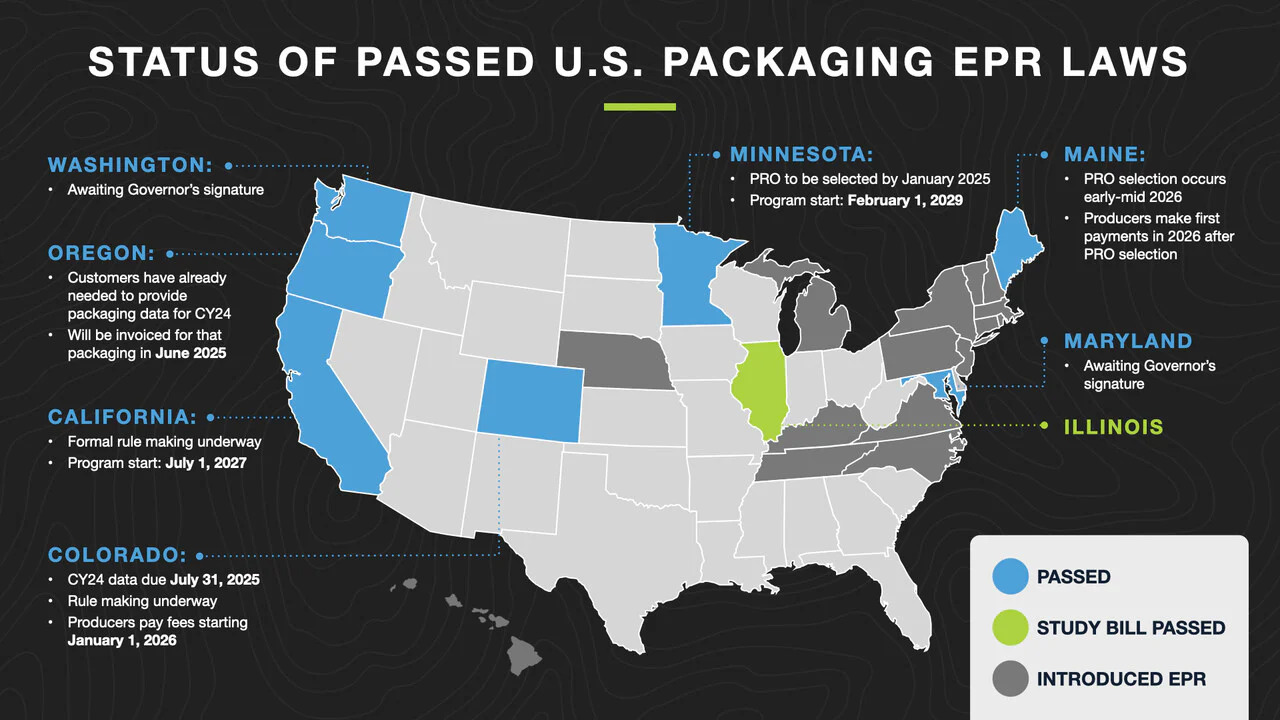
Map from A New Earth Project
Emerging & Proposed EPR Activity
Many additional states are actively considering or have introduced EPR legislation, including:
- Illinois
- Massachusetts
- New Jersey
- New York
- Rhode Island
- Connecticut
- Hawaii
- North Carolina
- Tennessee
In some cases, states are conducting needs assessments as precursors to full EPR laws. These are detailed studies that examine a state’s current recycling and waste management system to understand how well it works, identify gaps, and determine the infrastructure and services needed before or alongside implementing an EPR program.
For businesses operating in multiple states, EPR compliance planning is becoming more complex. Even companies in states without active producer responsibility laws may see indirect impacts through:
- Supplier cost adjustments
- Packaging redesign efforts
- National brand policy changes
Monitoring state-level packaging regulations is now a key risk management practice.
Does Compostable Packaging Reduce EPR Fees?
Compostable packaging is not automatically exempt from Extended Producer Responsibility (EPR) fees. However, how it is treated depends on state-specific legislation, access to composting infrastructure, and certification standards.
In many EPR programs, materials that are easier to recover and properly manage at the end of life may receive more favorable fee treatment. That means certified compostable packaging, especially when supported by strong commercial composting systems, can be part of a smart EPR strategy.
Some programs look at:
- Whether the material is third-party certified
- Whether composting infrastructure exists locally
- How clearly the packaging is labeled
- How likely it is to avoid landfill
In short, compostables are not automatically discounted, but in the right system, they can support lower environmental impact and better compliance outcomes.
It’s also important to note that reusable packaging often receives the strongest fee reductions under EPR programs. Compostables and recyclables can complement reuse systems where single-use packaging is still necessary (such as foodservice or organics collection).
Sydney Harris, Policy Director at Upstream Solutions, states, "In every packaging EPR program, returnable reusable packaging reduces producers' fees and reporting burdens. To minimize EPR compliance demands, work with your PRO (Producer Responsibility Organization) to transition to reuse systems."
Designing Packaging for EPR Readiness
Businesses preparing for packaging EPR compliance should consider:
- Reducing multi-material combinations
- Selecting materials aligned with established recycling streams
- Ensuring accurate labeling
- Tracking packaging weights and composition
- Evaluating end-of-life pathways
Thoughtful packaging design can reduce regulatory risk and long-term EPR costs.

What Should You Look for in a Packaging Partner Under EPR Laws?
As Extended Producer Responsibility laws expand across the United States, working with a knowledgeable packaging supplier becomes increasingly important.
Good Start Packaging focuses on material transparency, certified compostable options, and clear documentation, all of which support businesses as they navigate evolving EPR compliance requirements. Because EPR fees often depend on the material type, weight, and end-of-life pathway. Keep these factors in mind when you choose to-go boxes, cups, and other packaging. This can reduce long-term risk.
By prioritizing sustainable materials, verified certifications, and supply chain clarity, we help food-service operators make choices that align with emerging producer responsibility regulations.

Conclusion
Extended Producer Responsibility (EPR) laws are transforming packaging regulations in the United States. As more states adopt packaging EPR laws, producers will face reporting requirements, fees, and compliance obligations. The design and material choices will tie these together.
For manufacturers, distributors, and food-service businesses, understanding producer responsibility laws is essential for managing risk, controlling costs, and making informed packaging decisions. EPR is not simply an environmental initiative. It changes how organizations finance and manage material waste.
Businesses that review their packaging now can build stronger supplier partnerships. They can also match materials to changing recycling systems. This will help them as Extended Producer Responsibility programs expand across the U.S.