

In this article, we'll cover:
- What is the difference between upstream versus downstream?
- How are compostable containers meant to be discarded?
- What are the upstream benefits of compostable containers?
- What happens if you just throw away compostable items?
- What about recycled plastic?
What is the difference between upstream versus downstream?
Upstream refers to the functions that occur before a product is used by a consumer. Conversely, downstream refers to what happens after a product has been used and is at the end of its life. For example, upstream benefits of compostable packaging would include the renewable materials containers are made from and how they are produced. Downstream benefits would include what happens to the containers after they've been used to carry food or drinks.
How are compostable containers meant to be discarded?
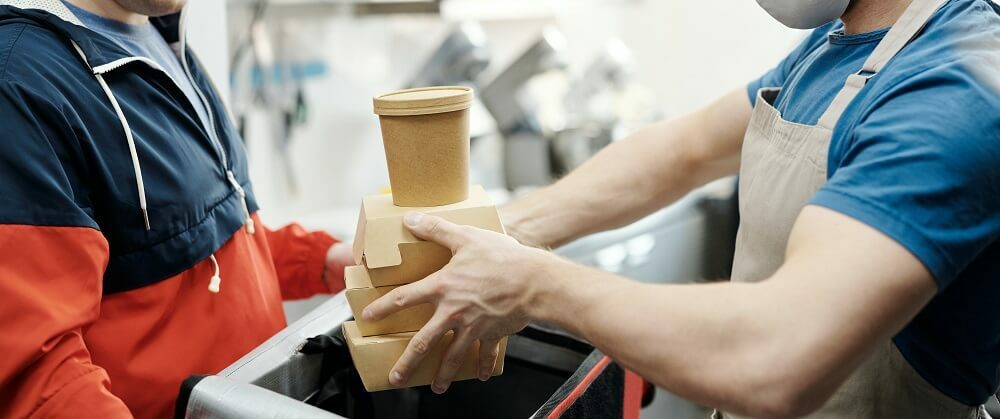
Compostable packaging is designed to break down into water, CO2, inorganic compounds and biomass. In other words, compostable packaging is intended to break down into nutrient-rich soil so that the original product is not visually distinguishable.
This disintegration process is meant to happen within a set period of time, usually within 90 days at a commercial composting facility or within 12 months in a home compost setting. Some compostable packaging is both home compostable and commercially compostable. Look for certifications like BPI and TÜV AUSTRIA to learn about how a product will breakdown.
Learn more about the differences between home composting and industrial composting in our guide. Locate a composter near you using our map.
What are the upstream benefits of compostable containers?
Even if you don't have commercial composting available in your community, there are still many benefits from using compostables.
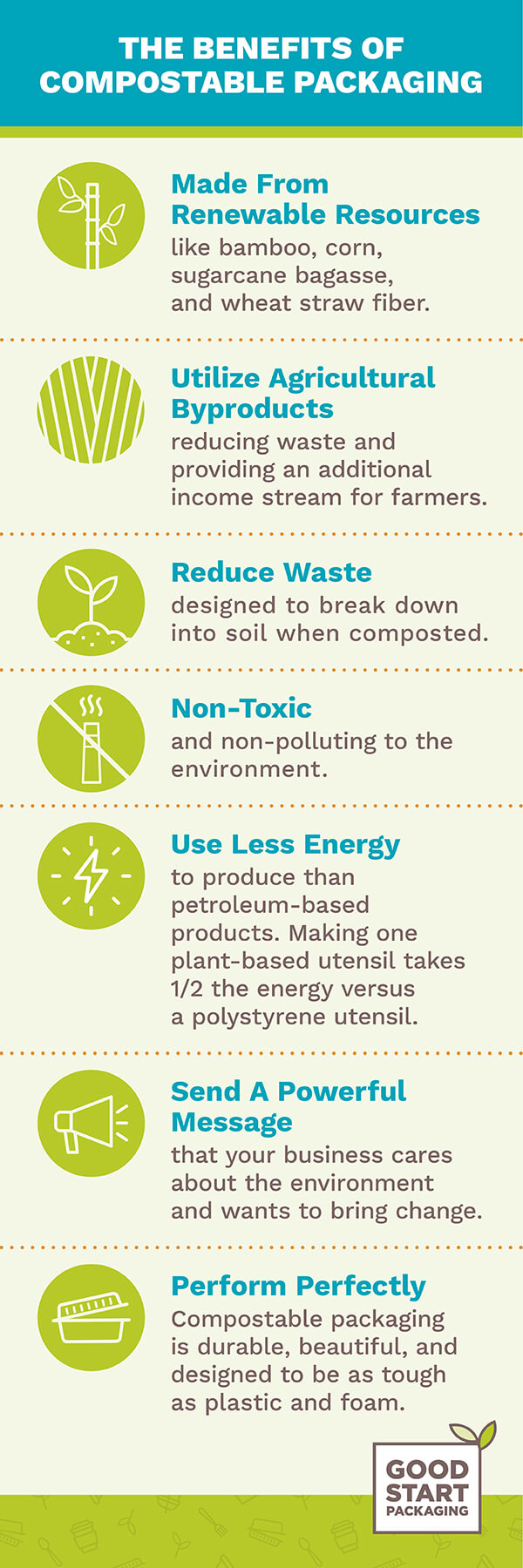
Made From Renewable Resources
The first upstream benefit is that compostable food service products come from renewable sources. The products we carry are made from plant-based materials like bamboo, sugarcane fiber, recycled paper, and corn.
Many of the materials used in compostable packaging are made from agricultural byproducts, or what is left over and unused after farming. Fiber from wheat, sugarcane and bamboo farming are prime examples. Previously, the stalks, leaves, and fibrous remnants were burned or left to compost. With compostable packaging, they are put to use to replace materials like foam and plastic while giving farmers and additional revenue stream.
Less Toxic Chemicals
The second benefit is that the production of compostable packaging doesn't involve toxic chemicals used in many traditional plastics. There's the styrene and benzene that workers and consumers are exposed to from polystyrene plastic. The dioxins in our environment from the use of chlorine bleaching of paper. And the small and large oil spills from petroleum extraction. None of these chemicals are issues with plastic alternatives like PLA and PHA.
Fewer Resources Needed To Manufacture
The third benefit is that many sustainable packaging solutions use less energy to produce than their plastic counterparts. For example, making cups with PLA creates 75% fewer greenhouse gases and 50% less non-renewable energy compared to conventional plastic cups made from petroleum.
Making cups with PLA creates 75% fewer greenhouse gases and 50% less non-renewable energy compared to conventional plastic cups made from petroleum.
Sustainable Demand Creates Sustainable Supply
Another benefit consumers get from buying compostable food service products is that it creates and supports demand for more responsible and sustainable products. This rewards manufacturers for continuing to innovate and drives down costs of plastic-free packaging.
It also sends a signal to municipalities to enable more permits to be created for commercial compost facilities to process these products into usable compost instead of filling up landfills.
Educates Consumers & Drives Change
Having consumers use compostable products and read that they are compostable creates awareness and education for compostable materials. This paves the way for drastically reducing plastic and foam use in the future. Use complimentary marketing assets to educate your customers about your choice to use sustainable food packaging.
What happens if you just throw away compostable items?
Unfortunately, compostable containers that are thrown in the trash will most likely end up in a landfill, where they will decompose and emit greenhouse gases. Even food emits methane when its sent to a landfill. The good news is that compostable containers will break down into organic plant-based materials versus plastic containers which break down into smaller microplastics and leech harmful chemicals.
What about using recycled plastic?
In case you were wondering, recyclable plastic like rPET (recycled PET) can play an important role in giving plastic a second life, but it is not a complete or long-term sustainability solution on its own.
rPET helps extend the usefulness of existing plastic by diverting some material from landfills and reducing the need for virgin plastic. That said, the broader recycling system has significant limitations.
On average, 93% of the plastic discarded each year is never recycled and instead ends up in landfills or the environment. Even among the small percentage that enters the recycling stream, much of it is downcycled, scrapped, or incinerated rather than remade into the same type of product.
Market economics and contamination remain significant barriers. Many plastics are not profitable to recycle, and food residue can render both plastic and paper unrecyclable. As a result, placing plastic in a recycling bin does not guarantee it will be recycled, despite common assumptions.
This is where compostable products offer a stronger long-term path forward. Designed to break down into soil when properly processed, compostables align more closely with a circular economy, especially for food-service applications where contamination is unavoidable.
Even in regions without commercial composting infrastructure today, choosing compostable products still matters. It signals demand, supports system change, and sends a clear message to communities, policymakers, and consumers that we are willing to invest in solutions that go beyond managing waste to eliminate it.